
Clinton, South Carolina, Wednesday, July 31, 2019, 12:15 a.m.

When last we checked in on Freddy Frost, he and “Horace” were becoming well acquainted.
As in the words of Johnny Cash, by way of Shel Silverstein, it was Gatlinburg in mid-July, and before continuing on to Nashville, after a day of writing in collaboration with an associate and chum, I decided to have a brew or five. Jed McCloughan made a few calls, and two others showed up at a sports bar where Jed knew the owner, and since it was a Wednesday night and no entertainment was scheduled, we congregated over in a corner, backed up against the plate-glass windows, and commenced to playing musical instruments and singing as we ate hot wings and shared pitchers. Jed and I played acoustic guitars. Jed’s wife, Ingrid, brushed on a snare drum, and another fellow whose name now escapes me had a harmonica he could make wail. It was a nickname, Sonny or Shorty, maybe, and I knew it when we were playing. It just disappeared amidst the suds.
 I was unworried. I had my electronic chauffeur, Freddy, to move me along to Nashville and then Louisville. This was to be a trip of great merriment, wrapped around the signing of a new and improved contract in Music City.
Jed and I played lots of new material, some of which we had written that very day. He sang some more of his, and I sang some more of mine. Our guests played instruments that didn’t require much prior knowledge of our work. “Sonny” (I think that’s his likely name) could do it professionally. I remember he ran a music shop, so, in some small way, he did. Jed said they got to know each other when both lived in Nashville. He and I fled the songwriting factories when the Internet made it possible, and when Jed landed in Gatlinburg, Sonny was already there. Jed said he stayed sharp by playing for tips at Sonny’s music shop on Thursday nights, and if I’d had a day to spare, I would have joined him.
At eleven, the owner dimmed the lights, and because all good things have an ending, I put my guitar in its case and climbed into Freddy, who obligingly popped his back gate before I got there. I reckon Freddy never sleeps. He remains active even when he’s inactive.
“To Nashville, Freddy!”
“Yes, at once, sir.”
“Freddy?”
“Yes, at once, Horace.”

I needed to sleep but couldn’t. Fun often leaves me that way. I felt exhilarated, not particularly drunk, though I had every right to be. As Freddy bypassed his way around the northern skirts of Knoxville, I wanted to talk, and I had enough truth serum in me to do so frankly.
“Freddy, what are the limits of my ownership?”
“Could you be more specific?”
“Okay, you monitor me, correct? You knew I was approaching with my guitar because you obligingly popped the lid.”
“That’s correct, Horace.”
“Is all the information you acquire private? Is it available to outside parties?
“Not as a rule,” he said.
“What exactly does that mean?” I asked.
“The information is not utilized in a specific sense. At regular intervals, general information regarding uses, miles covered, destinations, time frames … shall I continue?”
“No, I get the idea. Can I give you a hypothetical example?”
“As you wish.”

“For instance, what if I violated the law, and you had knowledge of it? Would you be obligated to furnish that information if it was wanted by, say, the cops?”
“Is there something I should know, Horace?”
“No, no. I was just thinking about it,” I said. “What if, right now, I had a large bag of marijuana stashed in my guitar case? Would you have knowledge of that?”
“Not unless you revealed it.”
“You couldn’t x-ray the contents?”
“No.”
“Is there a way an outside party could access your data base by plugging into it?”

“In some cases,” Freddy said, “it could be accessed by a certified Trek mechanic, but I know of no existing means for law enforcement personnel that could plug a device into my database directly.”
“In other words, Freddy, I do not have total control of a vehicle I own.”
“May I ask a question, Horace?”
“Yes.”
“Do you have a large bag of marijuana in your guitar case?”
“Of course not,” I said. “I said it was hypothetical. It’s just the first thing I thought of.”
“Yes, Horace.”
“I just wanted to define the parameters of the relationship between the two of us.”
“You could change the default settings.”
“How’s that?” I asked.
“Here’s a check box,” Freddy said. “By using the cursor with your finger, mark ‘hide personal information.’”
The check box interfered Seth Meyers’ monologue. I checked the box.
“Now hit ‘complete’.”
I did so.
“Very good, sir. Horace.”
“And, now, it’s inaccessible?”
“It’s more difficult to acquire. If you want to erase that information totally, it could be done, but I do not recommend it.”
“Why?” I asked.
“One reason would be that you’d find me considerably less intelligent,” Freddy said.
“I certainly wouldn’t want to stunt your growth.”
“Pardon me.”
“It was a joke, Freddy.”
“Yes. I see.”

“How could I dump the information in an emergency?”
“I recommend that you select a word that would begin the protocol. The checkbox would then come up on your screen, and you check it and hit ‘complete,’ and it will dump the personal database.”
“What if, say, I used the word ‘dump’?”
“Would you like me to set it up?” Freddy asked.
“Okay. What if I said ‘dump’ unintentionally?”
“The screen would come up, and you could check ‘cancel’.”
“Do it,” I said.
“As you wish.” I thought I detected a note of disappointment. Freddy thinks Daddy doesn’t trust him.
If you become a patron of mine, you’re supporting writing like this as well as my mostly NASCAR blogs at montedutton.com. If you’ve got a few bucks a month to spare, click here.
Another way I cobble out a living is with my books, a wide variety of which is available for sale here.
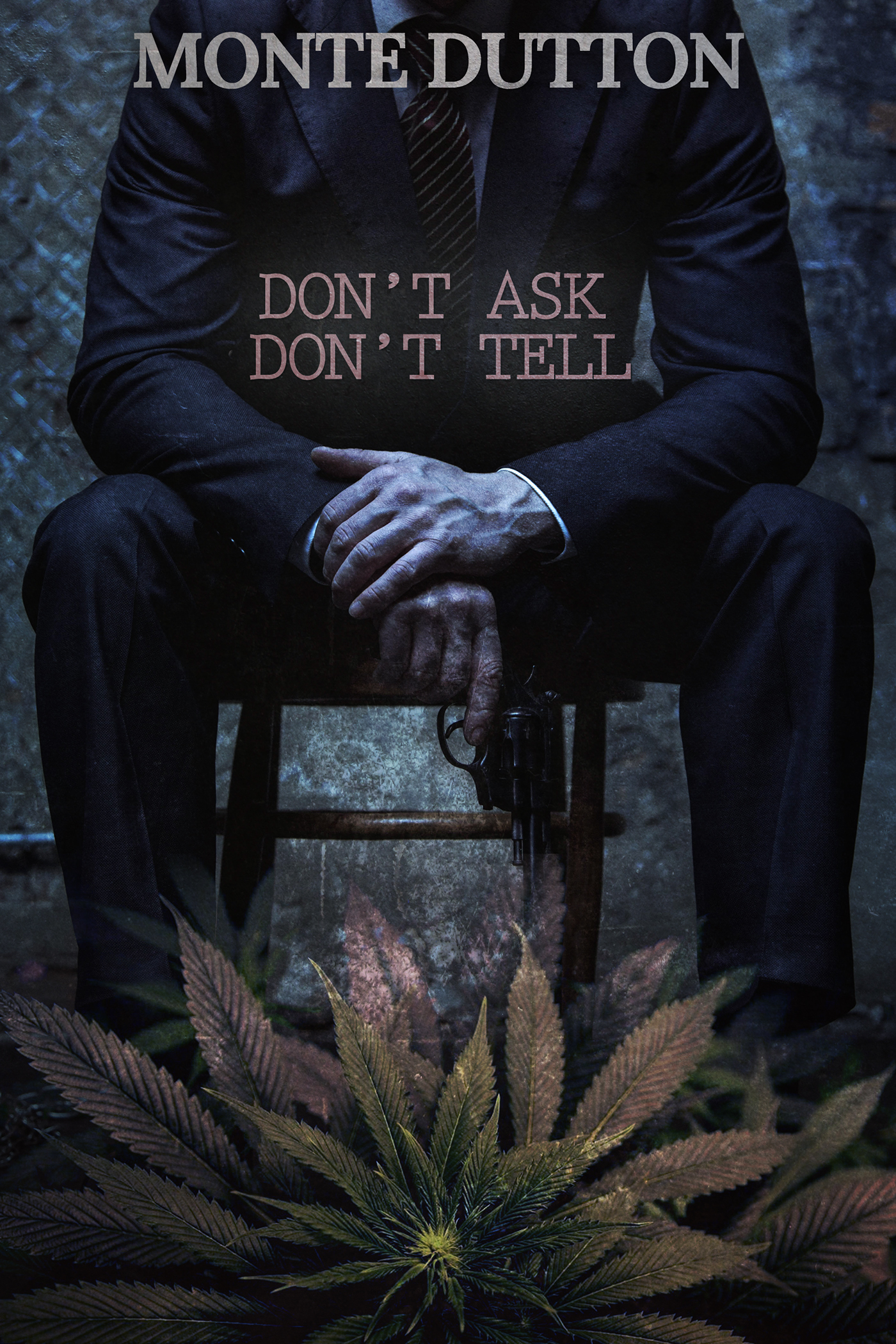
My eighth novel is called Don’t Ask, Don’t Tell.
Lightning in a Bottle is now available in an audio version, narrated by Jay Harper.
 Nightrider's Lament