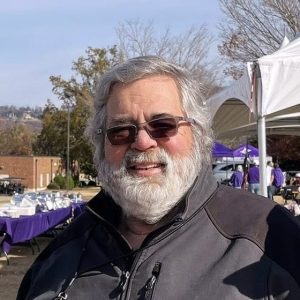


Clinton, South Carolina, Saturday, April 18, 2020, 8:37 a.m.

Back when I traveled most of the country, writing about race cars that went ’round and ’round and the mostly white men who drove them, my favorite device was not a shock absorber but its literary equivalent, satire.
Once — it was in Dover, Delaware, I think — I was angry at NASCAR for something and stormed back into the track’s media center and announced, “I’m never going to take these people seriously again. From now on, it’s satire, satire, satire!” Each time I said the word, I chopped an open palm with the other hand. For years afterward, one of my colleagues told others of this scene, drawing gales of laughter.
It was the same day that I walked to the opposite end of the mile track to where the racing trucks were lodged, looking desperately for something to write that would make me feel good about the sport again. It was where I encountered a mostly unknown Missouri driver named Carl Edwards for the first time.
Satire has largely fallen into disfavor today. At one time, satire was commonly used to poke fun of bigotry, ignorance and poverty. Nowadays, it’s hazardous to a writer’s health for him (or her) to use ridicule that strays from literal meanings.
Several items bequeathed me these thoughts when I most recently awakened. One was the Kyle Larson catastrophe, which I don’t think had anything to do with satire. His use of a term of racial derision has, at least in the short run, cost him most everything in terms of his racing career. Another was a song by David Allan Coe that played while I was sleeping lightly. Coe is a country singer who once thrived on satire and, in one song that never played on the radio but was widely cited for its satire even as it dabbled in racism, used the aforementioned word that begins with “n.” A third was the famed Mel Brooks movie Blazing Saddles, which ridiculed racism and many other topics through satire.

Last night I phoned my best friend in high school. We played football together. He was vastly better than I. In the 1970s, both of us were occasionally victims of the “n-word.” He was called one. By being his friend, I was occasionally called a commonly used caucasian term of derision, the “n-word” lover. Our football team had few problems where racism was concerned. The problem was in the community around us. Those of us who played successfully in that era believe we shaped that community’s enlightenment by doing so well that it rallied behind us.
I based my second novel, The Intangibles, on those years. A lot of it is true. A lot of it was made up, which is why it was fiction.
He and I laugh today, usually by phone because he doesn’t get back here often, about an incident when we were camping in the barn on our farm and started hearing noises. Both of us thought the Klan had tracked us down, even though the noises were apparently creations of our minds. Lying on bales of hay, we whispered about plans in case some sinister figure showed up at the top of the ladder in the barn’s loft. The Larson incident got us talking about those times last night.
Because of growing up on that farm, where two black families lived, I have always, at every stage of my life, counted black people among my best and most admired friends. We chose sides and played makeshift baseball games on concocted diamonds in which the bases were on a hill and the outfield was behind a barbed-wire fence. A childhood mentor who worked at my dad’s restaurant was a star lineman at the segregated high school, where sometimes my father would take me to watch him play while parked under trees behind one end zone. He went off to Vietnam to die two weeks after he got there. A part of my heart has been broken ever since.
In that generation, with war, rioting and assassinations occurring out on the outskirts of our souls, satire was a powerful defense mechanism. Without a sense of humor, all our hearts would have been wounded even more.
One of my favorite albums was 1974’s Good Old Boys by Randy Newman, which was a wildly satirical depiction of the South. He used the “n-word” throughout the song “Rednecks,” and it was a means of condemning those who used it.
We’re rednecks / We’re rednecks / Can’t tell our ass from a hole in the ground / We’re rednecks / We’re rednecks / Keepin the [you know the word] down.
I could see how times were changing 30 years later when I wrote my own satirical song, “There You Are.” One night I was performing the song in a little bar in Asheville, North Carolina. The first verse was:
I know a guy who’s a first-rate prude / Puts a lotta effort into really being rude / Probably like to catch me doin’ something crude / But he really don’t mean no harm / Another guy I know don’t like black folks / One won’t drink nothin’ but Diet Coke / One’s been known to make up quotes / But he can write like a sonuvabitch.
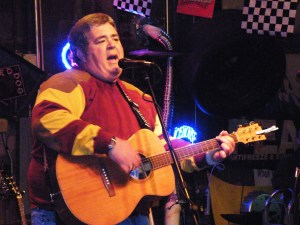
To my shock, when I took a break, a couple who was sitting in a booth past the other side of the bar, came up and got in my face, accusing me of being a racist. I defended myself by saying I was ridiculing racism. I expect they hadn’t really been paying attention, but that one line popped into their heads when I sang it. A couple others rose to my defense, and nothing more came of it except that shortly thereafter I changed the line from “don’t like black folks” to “is always broke.”
My status as a white southern liberal whose views were burnished in the fires of riot, war, death, scandal and the great traitor of my lifetime, Nixon, satire became my bullpen ace to be brought in when life’s bases were loaded.
Satire, and humor in general, seem in shorter supply. Hypocrisy is on the march. The world seems full of people who cheerfully pass along clear lies while at the same time railing against “fake news” without even acknowledging the irony.
The antisocial media bear much of the blame.
 If you enjoy my insights about racing and other subjects, make a small pledge of support. Rewards are in place for pledges of $5 or more. If 1/10 of my followers and Facebook friends pledge $1 a month, I’ll be set. Read all about it here.
If you yearn for my writing in larger doses, I’ve written quite a few books. Most are available here.

Lightning in a Bottle, the first of my two motorsports novels, is now available in audio (Audible, Amazon, iTunes) with the extraordinary narration of Jay Harper.
My eighth novel, a political crime thriller, is called Don’t Ask, Don’t Tell. It’s right up to date with the current political landscape in the country.
My writing on other topics that strike my fancy is posted here.
 Nightrider's Lament