
By MONTE DUTTON

I’m sure this review won’t be a big hit on the site analytics, but I’ve spent a lot time reading lately and resolved to write about each book after I completed it.
As I have stockpiled many books over the years that I haven’t gotten around to reading, this means most of them aren’t right off the current bestseller lists.
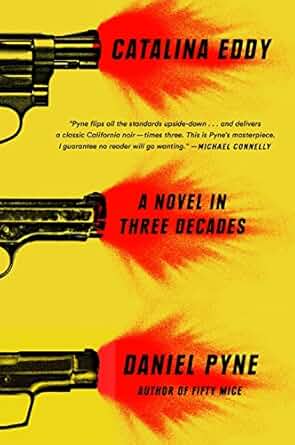
Last night I completed Catalina Eddy, by Daniel Pyne, which was released in 2017 (that’s hot off the press for me). I found it wildly entertaining because I love crime novels, not to mention films noir. Pyne’s novel is a “three-fer,” because it’s three novellas sharing a rough area but different times and characters.

Corruption and drugs run through all three like a sewer system.
“The Big Empty” is set in 1954 Los Angeles, “Losertown” in 1987 San Diego, and “Portuguese Bend” in 2016 Long Beach. In general, I enjoyed each one more than the one before it. They’re all good.
The title of the collection is based on the weather patterns of southern California. The Catalina Eddy is part of the reason the region is so often shrouded in “a marine layer” of haze, which is often simplified as being merely smog.
I love crime novels and was happy to discover this triumvirate as I am getting older and have outlived my favorite practitioners of the genre, Elmore Leonard and Dick Francis. I can’t find anything by either I haven’t already digested.
Pyne can turn a phrase, though not as well as Raymond Chandler, who was clever but not as outlandish as the sportswriter Dan Jenkins and the singer-novelist Kinky Friedman. Besides, they’re all wherever writers go in the hereafter now.
The author of Catalina Eddy is known primarily as a screenwriter. Among his credits are the 2004 remake of “The Manchurian Candidate“ and “Pacific Heights” (1990).

“The Big Empty” is set in a time of nuclear tests in the desert, when the government thought the only way to avoid mass destruction was to build as many such instruments as possible. A prominent scientist happens to be a murderous fiend on the side. A private investigator is after the murderer of his estranged wife.
Reagan-era politics sets the tone of ”Losertown,” where a scheming young federal prosecutor is at odds with a veteran investigator. Her goal is to ruin the San Diego mayor by any means possible. The investigator is determined not to let politics get in the way of justice.

“Portuguese Bend” is a story of the cooperation between a crime-scene photographer and a policewoman who is convinced that the authorities have arrested the wrong perpetrator of what seems a domestic murder. The cop is paralyzed in a shootout and wants to solve what is likely her last case.
The outcome of all three yarns was slightly more obvious than I would have preferred. The author tipped off a few too many of his pitches.

I watched a lot of baseball over the weekend — primarily because the heretofore sad-sack Red Sox won a series in the Bronx and I derive great pleasure from college playoff games – but the game reminds me of ways I’d like to revise the language.
A sportswriting colleague used to label me a pedant – “a person who is too interested in formal rules and small details that are not important” – and I grudgingly admit to a certain tendency.

When a batter belts a long home run, announcers are obsessed with “exit velocity,” often shortened to “velo.” It should be “impact velocity” because it’s measured when the ball leaves the bat, not when it leaves the park. Besides, it’s used on balls that aren’t even homers so they don’t even exit.
Any time a man with a bat in his hands does something with it, he’s a batter, that is, unless the ball hits him, at which point he becomes a “batsman.” I tend toward the traditional in most areas, but I think batsman is an archaic term .

English has a notable exception in that the past tense of “fly” should be “flied, not “flew.” If a batter “flew out to right,” it sounds as if he flapped his wings and soared off in pursuit of it. If he merely hits a fly ball – and I know of no exceptions – he flied out to right.
I hope all these rules of mine are reflected in the text of my baseball novel, The Latter Days.
It may not come into play in my two stock-car racing novels, Lightning in a Bottle and Life Gets Complicated. When a car is on the bumper of the one in front of it, that is one car length. If there is a gap between them, it’s technically two lengths. (By the way, announcers generally get this right in horse racing.) When auto-racing announcers refer to “car lengths,” they are apparently railroad cars.

On Monday night, I was rooting mildly for Murray State because I have a small connection to that Kentucky school, where I once interviewed for and was offered a job.
At the time of my visit, over 40 years ago now, the football coach was Frank Beamer, who shortly moved on to Virginia Tech. The assistant who succeeded him, Mike O’Cain, played quarterback for Clemson and later became head coach at North Carolina State. The head of the selection committee, Steve Newton, was then an assistant basketball coach to Ron Greene and later had a miserable tenure as head coach at South Carolina.

Had I taken that job, my life now would be quite different. It was something of a “Road Not Taken” event. I really liked Beamer and O’Cain but found Greene a bit pompous. Another factor at that particular point in time was that Murray State was situated in a dry county.
Three of the eight teams in the College World Series – Murray State from the Ohio Valley, Coastal Carolina from the Sun Belt and Oregon State from the PAC-12 — are from relatively small conferences. Only the Beavers and Washington State are left from the old PAC-12, where they are now paired with schools such as Arkansas Little Rock, Gonzaga and Colorado State.

On the other hand, the Chanticleers and Beavers have both won the MCWS in the past decade.

 Nightrider's Lament